The Rock of Cashel
A limestone outcrop above the Tipperary plain carries a round tower, a Romanesque chapel and a roofless cathedral: a thousand years of kings and bishops on one hilltop.
You see the Rock of Cashel long before you reach it. Driving across the flat farmland of County Tipperary, the outcrop rises from the plain with its cluster of grey towers and gables, more like a fortified town than a church. Its Irish name is Carraig Phádraig, Patrick's Rock, and for close to a thousand years it was a seat of power: first of the kings of Munster, then of the archbishops who succeeded them. It takes an hour or two to see, and it is the best single stop on the road from Dublin to the south-west.
A rock fit for kings
From around the fourth or fifth century, Cashel was the royal seat of the Eóganachta, the dynasty that ruled Munster. Legend says Saint Patrick came here in the fifth century and baptised the king, Aengus, and that during the ceremony he drove the point of his crozier through the king's foot by mistake; the king, thinking it part of the ritual, bore it in silence. Another story says the Rock itself was spat out by the devil, who bit it from a mountain to the north still called the Devil's Bit.
Brian Boru, the most famous of the high kings, was crowned at Cashel in the tenth century. In 1101 his great-grandson, King Muirchertach Ua Briain, gave the Rock to the Church, a gift that removed it from the reach of his rivals and turned a royal fortress into an ecclesiastical capital. Almost everything you see today was built after that.
Cormac's Chapel
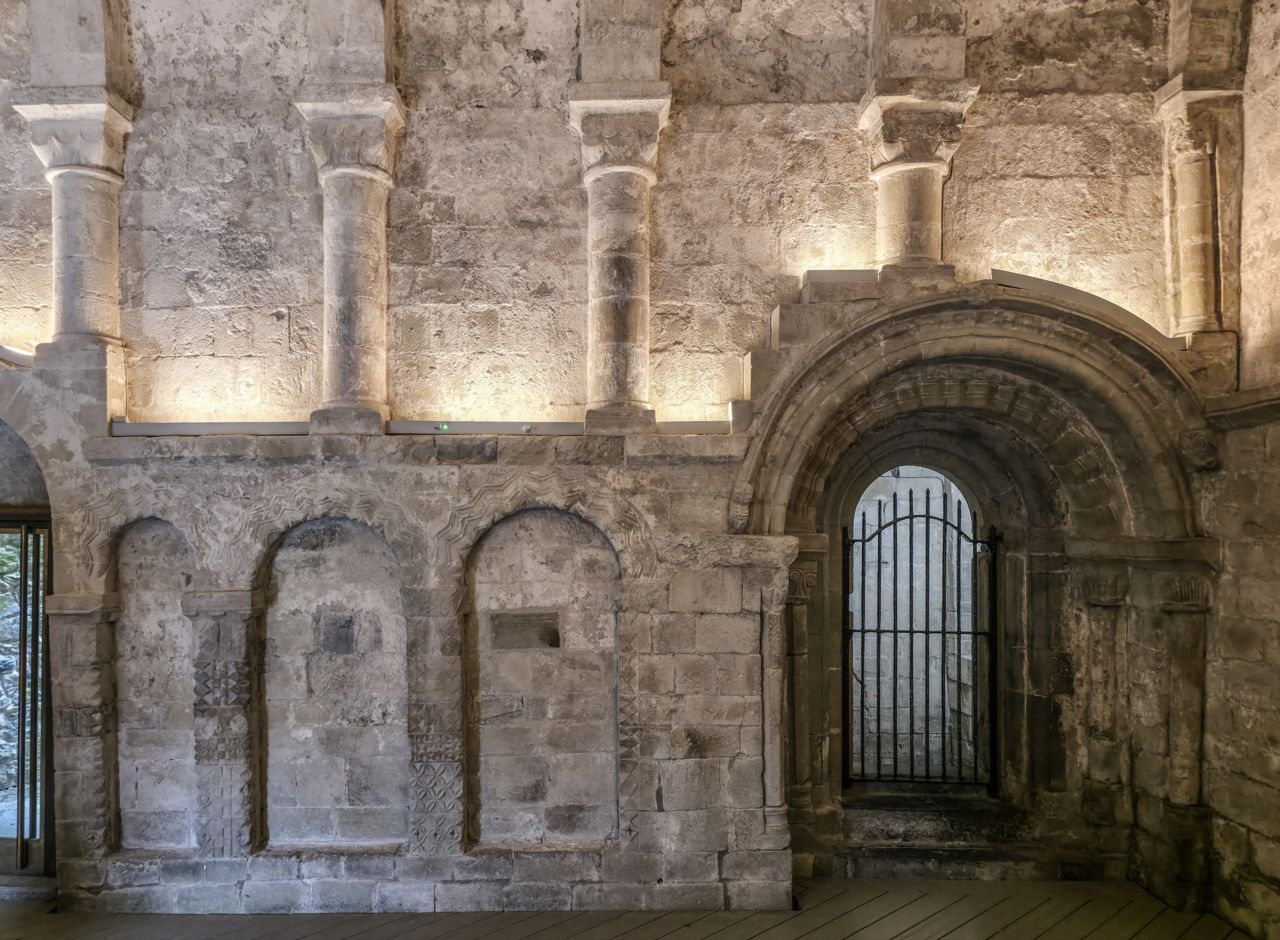
The finest building on the Rock is also one of the smallest. Cormac's Chapel was built by Cormac Mac Carthaig, king of Desmond, and consecrated in 1134. It is the earliest and most accomplished Romanesque church in Ireland, and it shows how closely Irish churchmen were watching Europe: the twin towers on either side of the nave are thought to echo churches in Germany, where Irish monks had houses at the time.
Inside, the walls are lined with blind arcades of round arches on short columns, and the chancel arch and doorways are carved with chevrons, beasts and human heads. Traces of painted plaster survive on the walls, among the oldest frescoes in Ireland, and a carved stone sarcophagus sits in the nave. The steep roof is made of stone, built over a vault, and has kept the inside dry for nearly nine hundred years, though damp has been a constant problem for the paintings. Because of that, entry to the chapel is sometimes limited to small guided groups or closed for conservation.
A detourNewgrange and the tombs of the Boyne valleyThe cathedral and the round tower
The round tower, about twenty-eight metres tall and probably built around the time of the gift in 1101, is the oldest standing structure on the Rock. Its doorway sits several metres up, as on most Irish round towers, which served as belfries and as stores for valuables. The great cathedral was built round it, and between it and the chapel, in the thirteenth century: a long Gothic church with a central tower, lancet windows and carved tombs. At its western end is a fortified tower house, added in the fifteenth century as a residence for the archbishop.
The cathedral has been roofless since the eighteenth century, when the Church of Ireland archbishop moved services to a new church in the town below and the lead was taken off. Grass grows in the nave, the windows frame the sky, and on windy days you hear the wind before anything else. The darkest day here came in 1647, during the wars of that decade, when a parliamentarian army under Lord Inchiquin stormed the Rock and killed the soldiers, clergy and townspeople who had taken shelter in the cathedral.
At the entrance, the Hall of the Vicars Choral, a fifteenth-century building restored as the visitor centre, holds the original St Patrick's Cross; the one outside is a replica. The graveyard around the cathedral is full of later high crosses and headstones, and from its wall you look straight down on the next stop.
Hore Abbey and the town
In the fields below the Rock to the west lie the ruins of Hore Abbey, a Cistercian house founded in the thirteenth century. It is free to walk to, usually empty, and gives the best view back up to the Rock, especially in the evening when the stone turns gold. A path leads down from near the Rock car park; it is a ten-minute walk, and you may need to cross a field with cattle.
Cashel town itself is a single long main street with a few side lanes, small enough to see in half an hour. In the grounds of the town's Church of Ireland cathedral, a short walk from the main street, stands a stretch of the medieval town wall.
Visiting the Rock
- The site is run by the state heritage service. Entry is paid, and short guided tours are usually included; tickets, hours and the arrangements for Cormac's Chapel change.
- Arrive early. Coaches on the Dublin to Killarney run tend to reach Cashel from late morning.
- Parts of the cathedral may be under scaffolding for long-running conservation work.
- The paths are uneven and the top is exposed; bring a windproof layer even on a mild day.
Cashel pairs well with Kilkenny, an hour to the east, on the same day, and many travellers carry on south-west from here to Kerry for Kenmare and the Ring of Kerry. If you want to see where the story of Irish monasteries began, its earliest chapter lies in the Wicklow Mountains at Glendalough.