Galway, the city on the Corrib
Galway is a medieval port, a university town and the gateway to Connemara and the Aran Islands, with a short, fast river running through it and the Atlantic at its door.
Galway, Gaillimh in Irish, sits where the River Corrib runs out of Lough Corrib into Galway Bay. For centuries it was a merchant port trading wine and salt with France and Spain, run by fourteen families known as the Tribes of Galway. Today it is a university city with a young population, a lively street life and a habit of filling up with festivals all summer. It is small enough to walk end to end in twenty minutes, and it makes a good two-night base for the west, with Connemara, the Burren and the Aran Islands all within reach.
The Latin Quarter
The old centre runs from Eyre Square, the city's main green, down a line of pedestrian streets to the river: William Street, Shop Street, High Street and Quay Street, with narrow lanes between them. The area around the lower end is called the Latin Quarter, and in the afternoons buskers, street performers and musicians fill it. On Shop Street, look for Lynch's Castle, a fortified stone town house of the late medieval period with carved window frames and gargoyles; it was the home of the most powerful of the Tribes.
Eyre Square itself is officially named after John F. Kennedy, who spoke here in June 1963, a few months before his death. In the square stands the Browne Doorway, the carved stone entrance of a seventeenth-century merchant's house, moved here from Abbeygate Street in 1905 and now standing alone like a gate to nowhere. Flags bearing the arms of the fourteen Tribes fly around the square, and down at the docks you may still see a Galway hooker, the brown-sailed wooden working boat that once carried turf and goods across the bay.
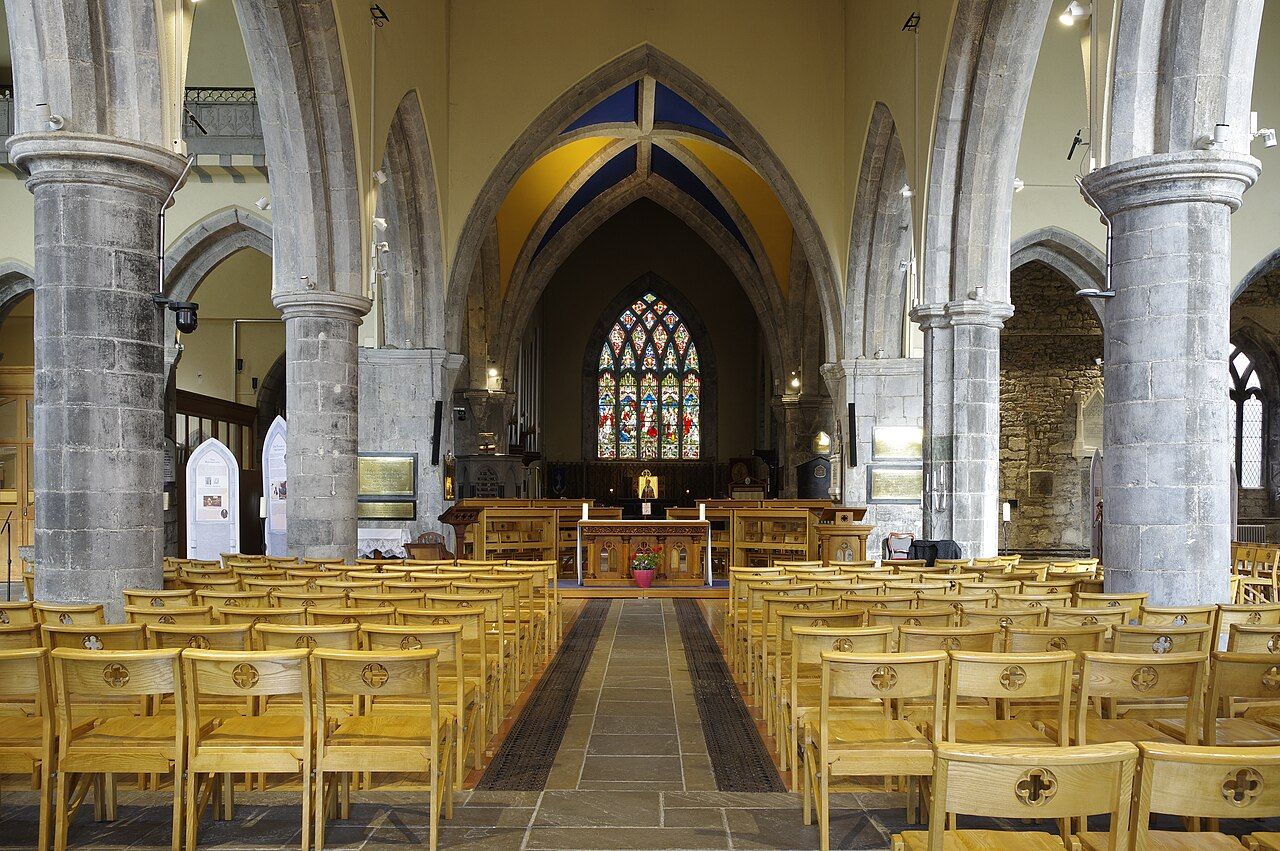
Just off the main street is St Nicholas' Collegiate Church, founded in 1320 and the largest medieval parish church in Ireland still in daily use. Tradition says Christopher Columbus prayed here on a voyage to Galway around 1477. Inside you will find medieval tombs, a carved font and later memorials; outside, on Saturdays, a market of food and craft stalls fills the street around it.
The Spanish Arch and the Claddagh
Where the river meets the bay stands the Spanish Arch, a stone arch built in 1584 as part of the town walls, and named, so the story goes, after the Spanish ships that unloaded in the docks beside it. Beside it, the Galway City Museum is free to enter and covers the city's history from medieval times through the Tribes, the Famine and the twentieth century. From the arch, the Long Walk, a row of tall painted houses along the quay, faces across the river to the Claddagh.
The Claddagh was once a fishing village outside the walls, with its own customs, its own elected king and its own Irish-speaking community. The thatched cottages were cleared in the 1930s, but the name lives on in the Claddagh ring, two hands holding a crowned heart, which local goldsmiths have made for over three centuries. Swans gather on the water at the mouth of the river, and the walk out along Nimmo's Pier gives a fine view back to the city.
A detourWestport and Croagh Patrick: a planned town under a holy mountainThe river
The Corrib is short, only about six kilometres from the lake to the sea, and fast: in winter it roars under the bridges. Walk upstream from the Spanish Arch along the riverside paths and canal banks. At the Salmon Weir Bridge, in the right season, you can look down and see salmon waiting below the weir before running up into Lough Corrib. Further up, the campus of the University of Galway, founded in 1845, has a limestone quadrangle in the Gothic style beside the river.
Two churches
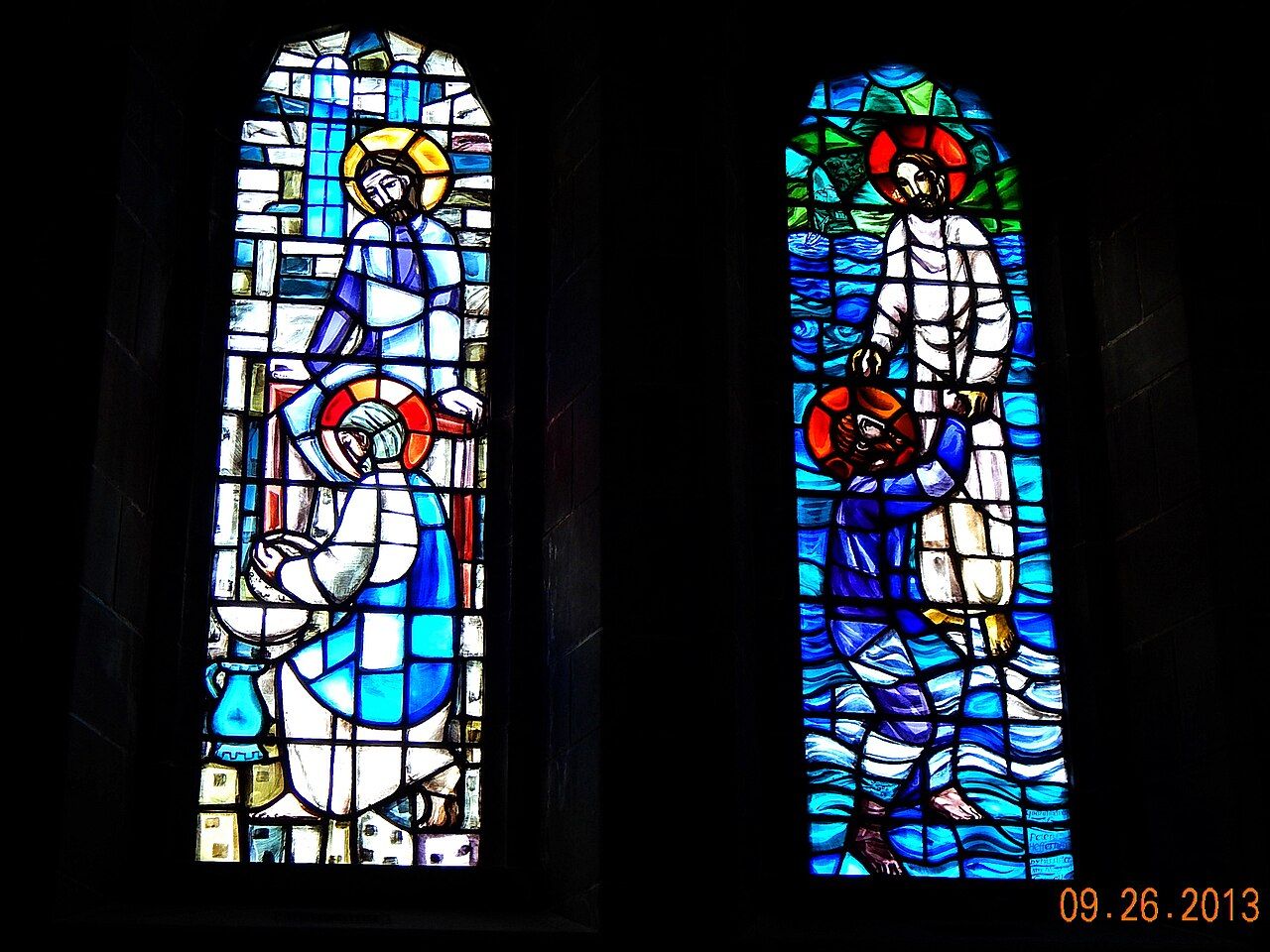
Across the Salmon Weir Bridge stands Galway Cathedral, completed in 1965 and among the last great stone cathedrals built in Europe. Its green copper dome is visible from across the city. Inside, it mixes Renaissance and other traditional styles with modern stained glass and mosaics, and it is lit in bright blue and red from the windows on a sunny afternoon. Compare it with St Nicholas', where six centuries of change have left layers of stone and memory, and you have the city's story in two buildings.

Salthill and the prom
West of the centre, the seaside suburb of Salthill has a long promenade along Galway Bay, about three kilometres long, popular with walkers, runners and swimmers at any hour. Tradition says that when you reach the end, at the Blackrock diving tower, you kick the wall before turning back. People swim from the diving boards all year round, but the water is cold and the tide matters; only swim where others do and in calm conditions. On a clear evening, the sun sets behind the hills of the Burren across the bay.
Festivals and moving on
Galway is known for festivals. Summer brings the most, with a large arts festival and a film festival in July and the horse racing week that takes over the city around the turn of July into August; an oyster festival follows in September. Dates and programmes change from year to year, and accommodation fills quickly in festival weeks.
Galway is the gateway to the west. Ferries to the Aran Islands leave from Ros a' Mhíl, about forty minutes west by road. The road north-west leads into Connemara, and south around the bay is the Burren. In the evening, the city's pubs are among the best in Ireland for music, and the guide to hearing traditional music explains how a session works.